By Oleksandr Honcharov, CEO at FlawlessMLM
Last updated: August 2026
Key Takeaways
- Network marketing is a distribution business model where independent representatives sell products directly to customers and earn commissions on both personal sales and sales generated by the people they recruit into the business.
- The terms "network marketing" and "multi-level marketing" (MLM) describe the same underlying legal and operational structure. They differ mainly in tone: network marketing reads as neutral and business-friendly, while MLM carries more baggage after decades of press coverage.
- The global direct selling industry generated USD 175.3 billion in retail sales during 2023 and supported 119.4 million independent representatives worldwide.
- Since 2004, FlawlessMLM has built the software backbone for 400+ network marketing companies across 90+ markets. The definition below reflects what these businesses actually look like at real scale.
Network Marketing Definition: The Core Concept
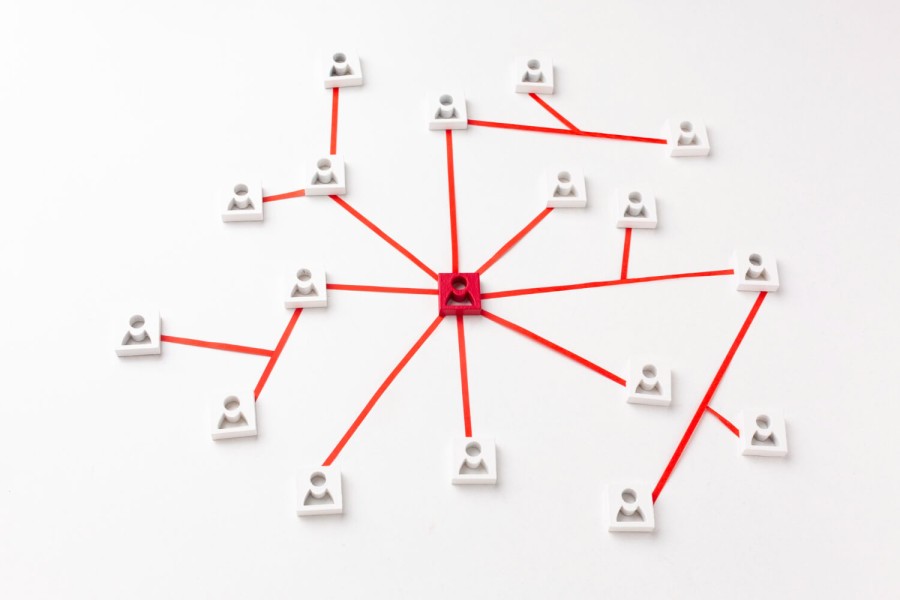
So what is network marketing at the operational level? It is a direct-to-consumer sales model. Independent representatives, not salaried employees, earn commissions on personal sales and on sales made by the team they build. That team, called a downline, is the "network" the model is named after. The company sells through the network. The network is paid by the company. No product touches a traditional retail shelf on the way to the buyer. That is the whole network marketing description in a single paragraph.
The formal network marketing definition used in business contexts adds one more element: the compensation plan. It is the rulebook that decides who earns what, when, and on which volume. Without a written and enforceable plan, a business built on this model cannot pay accurately. Inaccurate pay is the fastest way to lose the representatives who build the tree.
So what is a network marketing business at its structural core? Three parties are always present in it. The company owns the product and the compensation plan. The representative sells the product and recruits new representatives. The customer buys the product for personal use.
When those three roles stay clean and every payout is traceable, the model is legal in every major market and has been for decades. When the roles blur, the same activity turns into a pyramid scheme. That happens most often when the "product" is really a recruitment fee dressed up as a starter kit. Regulators shut those operations down.
Founders comparing this model against traditional retail or SaaS distribution can start with our overview of network marketing compensation plans. It breaks the math down by plan type, so trade-offs are visible before code is written.
The technical foundation for any of these plans is software that can calculate commissions correctly on every cycle. That is not a bookkeeping concern. It is the difference between a network that grows and a network that walks away after the second late payout.
Network Marketing Meaning or MLM Meaning: Are They the Same?
Yes and no. The network marketing meaning and the MLM meaning describe the same underlying structure. Independent sellers, tiered commissions, income from personal sales plus team sales. Regulators in the United States, the EU, and most of Asia treat them as the same category for tax and consumer-protection purposes.
That legal equivalence is what most first-time founders miss. When someone Googles "what is network marketing" and then Googles "what is MLM," they expect two different answers and rarely get them. Both queries surface the same industry, the same associations, and the same list of household-name companies.
Is network marketing the same thing as MLM?
In practice, yes. The two labels describe one industry, and companies use both interchangeably in their own literature. The wording difference is presentational rather than legal. "Multi-level marketing" describes the payout structure precisely: payouts flow up multiple levels of the tree. "Network marketing" reframes the same idea around what the business feels like from the inside. You build a network of people, you sell together, you earn together.
Why do two names exist for one model? Journalists and academics popularized "multi-level marketing" in the 1970s to describe the tiered payout math. Companies later adopted the network marketing label as a friendlier, less jargon-heavy phrase for new representatives. Both phrases have appeared in company marketing materials since the mid-1990s. Most of the top 100 direct selling brands published on the DSN Global 100 list use them interchangeably. For a full breakdown of the abbreviation itself, our MLM meaning explainer walks through the history and the regulatory positioning across major markets.
The important thing for founders is this. Choosing to call your company a network marketing multi level business or an MLM company changes nothing about your legal obligations. It changes nothing about your commission math or the software you need to run it. It only changes who feels comfortable joining you.
How to Define Network Marketing in Plain Terms
Ask ten people in the industry to define network marketing and you will get variations on the same theme. A company sells its product through independent people. Those people can bring in others to sell alongside them and earn a piece of that activity too. Anyone asking "what is network marketing" for the first time deserves an answer that short before diving into the mechanics.
That plain-language version is accurate. The technical version simply names each moving part. Sponsor: who recruited whom. Placement: where in the tree a new person sits. Volume: personal and group sales measured in PV and GV. Rank: the earned tier that unlocks bonuses. Payout: the money that comes out of the commission engine on schedule.
A useful way to define network marketing without any jargon is to compare it to two familiar business models it is not. It is not retail. No physical store, no walk-in customers, no shelf placement fees. It is not franchising either. Representatives own their book of customers but do not license a location. Their startup investment is measured in tens or hundreds of dollars rather than tens of thousands. Any answer to what is network marketing has to draw those two lines clearly, or the conversation drifts.
Somewhere between those two sits the network marketing business model, which our operational guide breaks down at the level of enrollment, sales, and payout mechanics.
One useful clarification: "network marketing and" what, exactly? The phrase gets Googled often as a comparison query. Most often as "network marketing and MLM," or "network marketing and direct sales," or "network marketing and pyramid schemes." All three are valid questions with different answers. The first two describe closely related legal categories. The third describes a legal category next to an illegal one that pretends to belong to it.
Network Marketing: What It Actually Looks Like Day to Day
The daily operating rhythm inside a network marketing business runs on three loops: enrollment, sales, and payout. Enrollment adds new representatives to the tree. Sales record every product order and attach it to a representative for commission purposes. Payout runs on a fixed cadence, weekly, biweekly, or monthly, and closes the accounting period. Founders often ask what is network marketing supposed to feel like at that operational level, and those three loops are the answer.
What does a network marketer actually do day to day?
A working representative handles four repeatable activities. They contact prospective customers about products they use themselves. They onboard the ones who want to buy or join. They check their back office to see which commissions have posted and which orders need follow-up. And they train the new people beneath them so those people can do the same four things independently. In our experience across 400+ platforms, the ratio between customer sales and team building shifts with rank. Early on, sales dominate. At leader ranks, coaching and reporting take over. Ready to turn your network marketing idea into a working platform? Talk to the FlawlessMLM team to discuss your model and next steps.
Behind the scenes, the software is doing continuous work. Every sale routes through the commission engine. The engine knows the plan rules, the current period, and the volume already earned by each upline representative. It also knows the rank thresholds each of them is trying to hit. On a Tuesday evening a representative places an order for USD 240 of supplements. Six or seven different upline accounts see their group volume update within seconds. The representative herself sees her rank progress bar move before she closes the app.
According to the WFDSA World Retail Sales Report, the global direct selling industry generated USD 175.3 billion in retail sales during 2023, supported by 119.4 million independent representatives worldwide.
That daily rhythm is only possible when the software behind it can handle real load. Global Trend illustrates the scale point clearly. In 2017, they had 42,000 partners managed manually in Excel and could not close a commission period without days of reconciliation. Our engineers built their binary platform with six bonus types and a multilingual back office in ten languages. Seven years later, the network reached 2 million users. The commission run that once took three days now closes in under an hour. That is what this industry looks like when the operational floor is solid.
For companies serious about running the model at scale, our MLM software platform is what makes the day-to-day workable rather than exhausting.
Common Misspellings: Networking Marketing, Netwok Marketing and Others
Search data reveals a persistent long tail of near-miss spellings for the phrase. "Networking marketing" (with the -ing on the wrong word) attracts more than 60,000 monthly searches globally. "Network martketing" is another common typo, with a doubled letter t, and "netwok marketing" with a dropped letter r. The space-collapsed "networkmarketing," typed as one word, pulls steady traffic too.
None of these are separate concepts. They are all the same industry, spelled slightly differently by people typing quickly on a phone. That networking marketing gets six-figure search volume tells us something useful. Many people searching this topic are hearing the phrase out loud before they see it written down. That matters for how you name a company and how you write your first landing page. A domain that only works with the exact spelling will lose those searches.
Some searchers even type networkmarketing as a single word, expecting a brand or a company name rather than a category. Others land on the shortened "what is net marketing" or "what is net marketing about," dropping half the phrase entirely. A separate cluster of users type "network marketing what is" with the words reversed, the way a non-native speaker might phrase the question aloud. Others still type "network marketing what is it" as a run-on. All of these queries share the same underlying intent and all of them belong on any serious content plan for the topic.
The other pattern worth noting is the compound query "network marketing multi level marketing," which explicitly spells out the equivalence between the two names. That phrasing shows up in company literature, on regulatory websites, and in academic papers that want to signal to a reader that the labels are interchangeable. It is not a misspelling. It is a deliberate choice to name the entire concept without leaving room for ambiguity.
For the record: the correct spelling is "network marketing," two words, no extra letters. Everything else (networkmarketing, netwok marketing, network martketing, networking marketing) points at the same industry we have been describing throughout this piece.
Who Is a Network Marketer, and What Do They Actually Do
A network marketer is an independent representative of a company that operates on the network marketing model. They are not an employee. They receive no salary, no benefits, no company laptop. What they get instead is a compensation agreement, a starter kit or product catalog, and a back-office account. That account is where they see their sales, their team, and their earnings. Any accurate network marketing description of the role begins with that distinction.
Their income comes from two sources.
First, retail margin on products they sell to end customers.
Second, commissions and bonuses on the sales volume produced by the representatives in their downline, calculated according to the plan the company has published. A network marketer at the leader ranks may earn most of their income from the second source. A brand-new representative earns almost exclusively from the first.
Practically, most active network marketers spend their day cycling between three tools. A messaging app to talk to customers and team members. A replicated website or personal storefront to take orders. And the company back office to check numbers. When those three tools do not talk to each other cleanly, the representative wastes hours copying information between them. Hours lost at the representative level compound quickly into churn at the company level.
The most common complaint we hear from founders considering a platform switch is not "our commission math is wrong." It is "my leaders spend more time managing spreadsheets than they spend recruiting." That is a solvable problem, and it is the one FlawlessMLM was built to solve.
For the trade-offs between a template solution and a fully custom build, our MLM consulting engagement covers the discovery process from plan review through go-live.
One honest limitation worth naming. The network marketing model works best when the product has enough intrinsic value that customers would buy it even without an income opportunity attached. When representatives sign up only to qualify for commissions, the tree hollows out within two or three commission periods. No software can fix that.
MLM against Network Marketing: Side-by-Side Comparison
Here is the practical difference between the two labels in a single view. The rows below cover the six dimensions founders and journalists ask about most often when comparing the terms.
|
|
|
|
|
|
|
|
|
|
|
|
|
|
|
|
|
|
|
|
|
|
|
|
|
|
|
|
Both terms describe the same thing. Pick the one your audience finds easier to trust, and use it consistently on every touchpoint, from your homepage headline down to your commission agreement. A clean, single-label network marketing description across your entire brand does more for representative confidence than any glossary page ever will. Consistency there also feeds directly into the network marketing meaning your prospects hold in their heads before they ever speak to a recruiter.
Industry Context: Where the Network Marketing Model Stands in 2026
The direct selling industry, the umbrella under which network marketing sits, is one of the largest and most globally distributed retail channels in the world. According to the World Federation of Direct Selling Associations, the industry recorded USD 175.3 billion in global retail sales during 2023. That volume was distributed across 119.4 million independent representatives in more than 170 markets. The top ten markets alone account for roughly two-thirds of total volume. The United States, South Korea, Germany, China, and Japan lead the list.
In the United States alone, the Direct Selling Association reported USD 36.7 billion in retail sales for 2023, generated by 6.7 million direct sellers active during the year.

Two structural trends define the model in 2026.
First, the split between traditional in-person selling and social-media-driven "social selling" continues to widen. Modern representatives expect replicated storefronts, integrated CRM, and a mobile back office on day one, not as a premium add-on.
Second, the average time-to-launch for a new brand has compressed dramatically. What used to take six to eight months of custom development now completes in one to two months on a package solution. That assumes the compensation plan is decided upfront.
FlawlessMLM was founded in Estonia and has since delivered 400+ MLM projects across 90+ countries. Our team was named MLM Market Leader by Software Suggest in 2025. That footprint is why the definitions above are practical rather than theoretical. Every claim in this article sits on top of a project pattern we have seen work or fail at scale.
For companies weighing entry into this model, the deciding question is rarely "should we use network marketing." It is usually "which compensation plan fits the product." And, closely behind, "what software will still hold when the network hits its first 10,000 representatives." Both questions have answers. Both are cheaper to answer before launch than after.
If you are ready to move from understanding network marketing to actually building a business around it, the next step is turning your compensation model into a platform that can support real growth. FlawlessMLM has been building MLM and network marketing platforms since 2004, helping brands move from the initial plan through development and launch with the right technical and operational structure in place. Talk to the FlawlessMLM team to discuss your compensation plan, target market, and launch requirements, and get a clear view of what it will take to turn your idea into a working platform.
Network marketing is a sales model where a company distributes its products through independent representatives instead of retail stores. Those representatives earn a commission on what they sell personally and on what the people they recruit sell as well. The name comes from the network of representatives that grows as each person invites others to join and sell alongside them. When someone asks "what is a network marketing business," that short answer covers most of the ground.
The four most common misspellings in Google search data are "networking marketing" (the -ing suffix on the wrong word) and "network martketing" (a doubled t). The other two are "netwok marketing" (a dropped r) and the space-collapsed "networkmarketing." All four point to the same industry. If you publish content in this niche, alternate spellings are worth accounting for in your on-page copy. Collectively, they pull in six figures of monthly search volume.
The formal network marketing definition used in industry associations and academic literature reads roughly as follows. It is a distribution channel in which independent contractors sell goods or services directly to consumers. They are compensated both for personal sales volume and for the sales volume produced by the representatives they sponsor. Because the terms are legally identical, the same definition also covers what is network marketing multi level marketing in academic literature. The World Federation of Direct Selling Associations and the U.S. Direct Selling Association use materially the same wording in their public statistics reports.
Yes. Network marketing is legal in every U.S. state, in all major EU markets, and in the vast majority of countries worldwide. The line that separates a legal network marketing company from an illegal pyramid scheme is drawn by the U.S. Federal Trade Commission and equivalent regulators abroad. The core test is whether income flows primarily from selling products to end customers or primarily from recruitment fees. Companies that pass that test, and thousands do, operate lawfully year after year.


